
The development of the London underground railway là bài đọc xuất hiện trong đề Cam 17, Test 1, Reading Passage 1, tại bài viết dưới đây, hãy cùng Ôn luyện xem qua đáp án cũng như giải thích đáp án cho từng câu:
Đề bài
Cùng Edmicro đọc kỹ đề bài The development of the London underground railway để có thể làm bài thật tốt nhé!
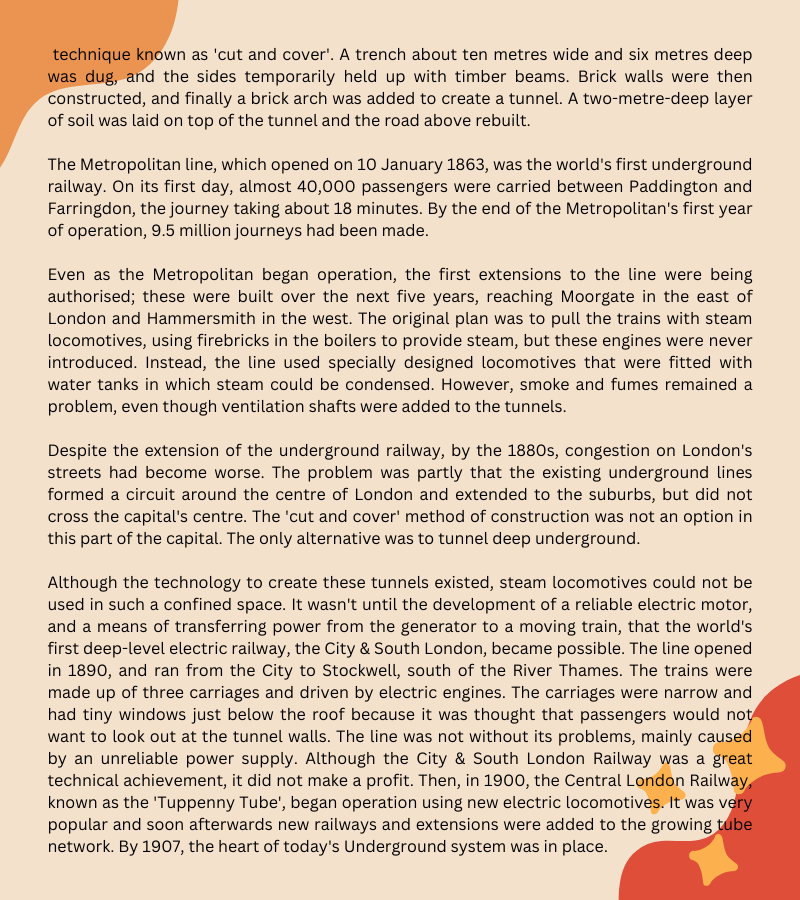
Bài đọc:

Câu hỏi:
Đáp án đề The development of the London underground railway
Cùng Edmicro so sánh đáp án tại bảng dưới đây nhé!
| Câu hỏi | Đáp án |
| 1 | population |
| 2 | suburbs |
| 3 | businessmen |
| 4 | funding |
| 5 | press |
| 6 | soil |
| 7 | False |
| 8 | Not given |
| 9 | True |
| 10 | True |
| 11 | False |
| 12 | False |
| 13 | Not given |
Xem thêm: Changes In Reading Habits | Giải Cambridge IELTS 16, Test 4, Reading Passage 2

Giải thích đáp án đề The development of the London underground railway
Dưới đây là giải thích chi tiết cho từng câu hỏi:
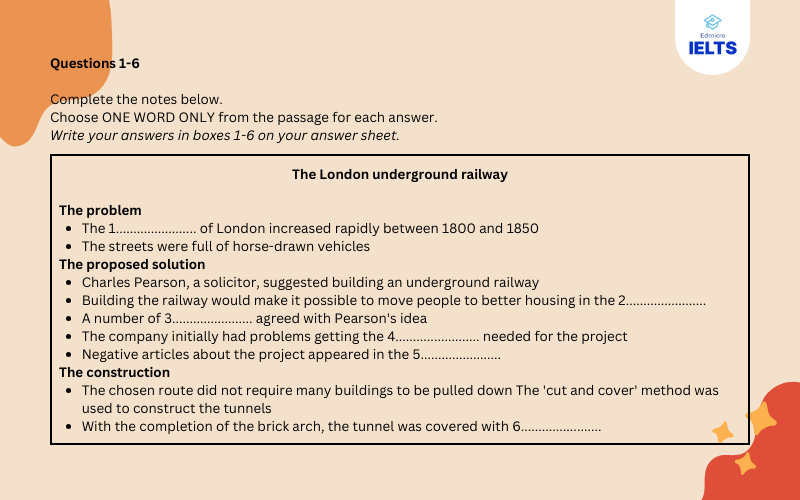
Câu 1 – 6
Câu 1
Từ khóa cho câu hỏi: problem, London, increased rapidly, between 1800 and 1850
Đối với câu hỏi này, chúng ta phải xem xét đoạn văn đầu tiên. Ở đây, ngay dòng đầu tiên, tác giả nói rằng, “In the first half of the 1800s, London’s population grew at an astonishing rate …”
Ở đây,
- the first half of the 1800s = between 1800 and 1850
- grew at an astonishing rate = increased rapidly
Vậy, câu trả lời là: population
Câu 2
Giải pháp được đề xuất:
- Charles Pearson, một luật sư, đã đề xuất xây dựng một tuyến đường sắt ngầm
- Việc xây dựng tuyến đường sắt sẽ giúp người dân có thể di chuyển đến nơi ở tốt hơn ở________________
Từ khóa cho câu hỏi: proposed solution, Charles Pearson, suggested, building, underground railway, would make it possible, move people, to better housing in,
Dòng 1-6 của đoạn số 2 có ghi, “Amongst the most vocal advocates for a solution to London’s traffic problems was Charles Pearson, who worked as a solicitor for the City of London. He saw both social and economic advantages in building an underground railway that would link the overground railway stations together and clear London slums at the same time. His idea was to relocate the poor workers who lived in the inner-city slums to newly constructed suburbs, and to provide cheap rail travel for them to get to work. . .. .. .. .”
Ở đây, newly constructed suburbs = better housing in the suburbs.
Vậy thì câu trả lời là: suburbs
Câu 3
A number of__________ agreed with Pearson’s idea
Từ khóa cho câu hỏi: a number of, agreed with, Pearson’s idea
Ở dòng 6-7 của đoạn số 2, tác giả viết, “ . . . . … .. Pearson’s ideas gained support amongst some businessmen and in 1851 he submitted a plan to Parliament .. .”
Ở đây,
- gained support = was agreed by
- some = a number of
Vậy thì câu trả lời là: businessmen
Câu 4
The company initially had problems getting the ____________ needed for the project
Từ khóa cho câu hỏi: the company, initially, had problems, getting, needed for the project
Ở đoạn số 3, hãy xem xét kỹ dòng số 4, “ … … .. The organisation had difficulty in raising the funding for such a radical and expensive scheme, . .. .. .”
Ở đây,
- the organisation had difficulty = The company initially had problems
- raising = getting
- a radical and expensive scheme = the expensive project
Vì vậy, câu trả lời là: funding
Câu 5
Negative articles about the project appeared in the 5. ____________
Từ khóa cho câu hỏi: negative articles, about the project, appeared in
Một lần nữa, trong đoạn số 3, hãy xem xét kỹ các dòng 4-5, “ … … .. The organisation had difficulty in raising the funding for such a radical and expensive scheme, not least because of the critical articles printed by the press. . .. .. .”
Ở đây,
- critical articles = negative articles
- printed = appeared in
Vì vậy, câu trả lời là: press
Câu 6
With the completion of the brick arch, the tunnel was covered with 6. ______________
Từ khóa cho câu hỏi: the construction, with, completion of the brick arch, the tunnel, was covered with
Trong đoạn số 4, hãy xem những dòng cuối cùng, “ . . … .. Brick walls were then constructed, and finally a brick arch was added to create a tunnel. A two-metre-deep layer of soil was laid on top of the tunnel and the road above rebuilt.”
Ở đây,
- finally a brick arch was added = the completion of the brick arch
- was laid on top of the tunnel = the tunnel was covered with
Vậy, câu trả lời là: soil
Giải thích đáp ánXem thêm: Roman Shipbuilding And Navigation | Giải Cambridge IELTS 16, Test 3, Reading Passage 1
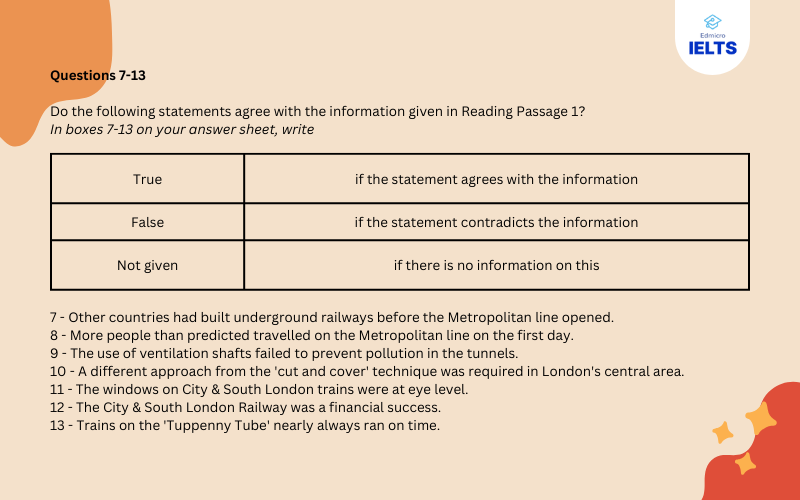
Câu 7-13
Câu 7
Other countries had built underground railways before the Metropolitan line opened.
Từ khóa cho câu hỏi: other countries, built, underground railways, before, Metropolitan line, opened
Dòng đầu tiên của đoạn số 5 đưa ra câu trả lời cho câu hỏi này, như tác giả của văn bản nói ở đây, “The Metropolitan line, which opened on 10 January 1863, was the world’s first underground railway…”
Ở đây: was the world’s first underground railway = NO other countries had built underground railways before the Metropolitan line
Vậy câu trả lời là: NO
Câu 8
More people than predicted travelled on the Metropolitan line on the first day.
Từ khóa cho câu hỏi: more people, than predicted, travelled, Metropolitan line, first day
Chúng ta không tìm thấy bất kỳ thông tin nào liên quan đến số lượng hành khách dự kiến trên tuyến Metropolitan vào ngày đầu tiên. Trong đoạn số 5, tác giả chỉ đề cập, “. . . On its first day, almost 40,000 passengers were carried between Paddington and Farringdon, the journey taking about 18 minutes . . . .”
Vậy là thiếu thông tin trong câu hỏi .
Vậy thì câu trả lời là: NOT GIVEN
Câu 9
The use of ventilation shafts failed to prevent pollution in the tunnels.
Từ khóa cho câu hỏi: use of ventilation shafts, failed to prevent, pollution, tunnels
Hãy xem những dòng cuối của đoạn số 6. Tác giả nói ở đây, “ . . .. . However, smoke and fumes remained a problem, even though ventilation shafts were added to the tunnels.”
Ở đây,
- smoke and fumes remained a problem = pollution problem in the tunnels
- even though ventilation shafts were added = The use of ventilation shafts failed to prevent pollution
Vậy thì câu trả lời là: TRUE
Câu 10
A different approach from the ‘cut and cover’ technique was required in London’s central area.
Từ khóa cho câu hỏi: a different approach from, ‘cut and cover’ technique, was required, London’s central area
Hãy xem những dòng cuối của đoạn số 7. Tác giả nói ở đây, “ . . .. . The ‘cut and cover’ method of construction was not an option in this part of the capital. The only alternative was to tunnel deep underground.”
Ở đây,
- The ‘cut and cover’ method of construction was not an option = the tunnel required a different approach from the ‘cut and cover’ technique
- this part of the capital = London’s central area
- The only alternative was to tunnel deep underground = the different approach
Vậy thì câu trả lời là: TRUE
Câu 11
The windows on City & South London trains were at eye level.
Từ khóa cho câu hỏi: windows, City & South London trains, were at eye level
Hãy xem dòng 6-7 của đoạn số 8. Tác giả nói ở đây, “ . . . . . The carriages were narrow and had tiny windows just below the roof because it was thought that passengers would not want to look out at the tunnel walls . . . . . . .”
Ở đây, just below the roof . . .. . . passengers would not want to look out at the tunnel walls = NOT at eye level
Vậy câu trả lời là: NO
Câu 12
The City & South London Railway was a financial success.
Từ khóa cho câu hỏi: City & South London Railway, was, financial success
Dòng 8-9 của đoạn số 8 viết rằng, “ . . . . . . Although the City & South London Railway was a great technical achievement, it did not make a profit… .”
Ở đây, it did not make a profit = a financial failure, NOT a success
Vậy câu trả lời là: NO
Câu 13
Trains on the ‘Tuppenny Tube’ nearly always ran on time.
Từ khóa cho câu hỏi: trains, the ‘Tupenny Tube’, nearly always ran, on time
Ở đoạn số 8, tác giả có nhắc đến Tuppenny Tube’ in line no. 10. However, there is NO MENTION of the Tuppenny Tube running on time or not.
Vậy thì câu trả lời là: NOT GIVEN
Trên đây là bài mẫu gợi ý cho đề The development of the London underground railway đề Cam 17, Test 1, Reading Passage 1 được đội ngũ chuyên môn tại Ôn luyện biên soạn. Hy vọng bài viết trên sẽ giúp ích cho các bạn trong quá trình Ôn luyện IELTS tại nhà.
Xem thêm:
- Why Fairy Tales Are Really Scary Tales | Giải Cambridge IELTS 15, Test 3, Reading Passage 3
- Roman Tunnels | Giải Cambridge IELTS 16, Test 4, Reading Passage 1