Pick from a list IELTS Listening là một trong những dạng đề xuất hiện nhiều trong các đề thi IELTS thực tế. Hãy cùng Ôn Luyện làm chủ dạng đề này với các bước thực hiện chi tiết nhất nhé!
Pick from a list IELTS Listening là gì?
Dạng bài Pick from a list trong bài thi IELTS Listening là một trong những dạng bài thường gặp, yêu cầu thí sinh lựa chọn đáp án đúng từ một danh sách các lựa chọn có sẵn.
Các lựa chọn này có thể liên quan đến nhiều loại thông tin khác nhau như tên người, địa điểm, thời gian, đặc điểm,… để phù hợp với câu hỏi hoặc thông tin được nghe trong bài.
Ví dụ: Bạn sẽ nghe một đoạn hội thoại về việc lên kế hoạch cho một chuyến đi. Sau đó, bạn sẽ được yêu cầu chọn ra các địa điểm mà nhóm bạn sẽ đến thăm từ một danh sách các địa điểm đã cho.
Các vấn đề thường gặp với dạng đề Pick from a list
Với dạng đề này, người học thường bị mắc phải những tình huống sau đây:
- Nhầm lẫn giữa các lựa chọn. Các lựa chọn thường có điểm khác nhau về cách viết hay ý nghĩa khá chi tiết.
- Không nghe kỹ các chi tiết. Việc không chú ý đến các chi tiết nhỏ trong bài nghe có thể dẫn đến việc bỏ lỡ thông tin quan trọng để chọn đáp án đúng.
- Thừa hoặc thiếu số lượng từ của đáp án. Với mỗi đề bài, ta có những quy định khác nhau về số lượng từ/ số trong câu trả lời.
Xem thêm: Lộ Trình Học IELTS Đơn Giản, Tiết Kiệm, Dễ Dàng Đạt Band
Bí quyết đạt band điểm cao dạng đề Pick from a list
Để sẵn sàng với kỳ thi sắp tới, người học có thể tham khảo những bước thực hiện dạng đề này dưới đây cùng Ôn Luyện nhé!

Bước 1: Đọc kỹ hướng dẫn. Đọc kỹ hướng dẫn để hiểu rõ yêu cầu của bài làm và số lượng đáp án cần chọn.
Ví dụ: Đề bài có thể yêu cầu bạn chọn hai địa điểm mà người nói sẽ đến thăm trong kỳ nghỉ.
Bước 2: Quét qua các lựa chọn. Nhẩm đọc qua các lựa chọn để có cái nhìn tổng quan và tìm kiếm các từ khóa chung.
Ví dụ: Danh sách lựa chọn có thể bao gồm các địa điểm như “beach”, “museum”, “mountain”, “forest”. Bạn hãy tìm kiếm các từ khóa liên quan đến địa điểm và hình dung ra từng lựa chọn trong đoạn audio.
Bước 3: Nghe và ghi chú. Trong khi nghe, hãy ghi chú lại những thông tin quan trọng liên quan đến các lựa chọn.
Ví dụ: Khi nghe, bạn có thể ghi chú: “likes swimming”, “interested in history”.
Bước 4: So sánh và chọn đáp án. Sau khi nghe xong, so sánh các ghi chú của bạn với các lựa chọn và chọn ra những đáp án phù hợp nhất.
Ví dụ: Dựa vào ghi chú, người nói thích bơi và quan tâm đến lịch sử, đáp án sẽ là “beach” và “museum”.
Bước 5: Kiểm tra lại. Sau khi hoàn thành, hãy dành thời gian để kiểm tra lại xem bạn đã chọn đúng số lượng đáp án yêu cầu. Các đáp án đó có phù hợp với thông tin bạn nghe được hay không.

Bài tập vận dụng Pick from a list IELTS Listening
Cùng Ôn Luyện làm bài tập dưới đây để nắm vững cách làm dạng bài Pick from a list nhé!
Đề bài:
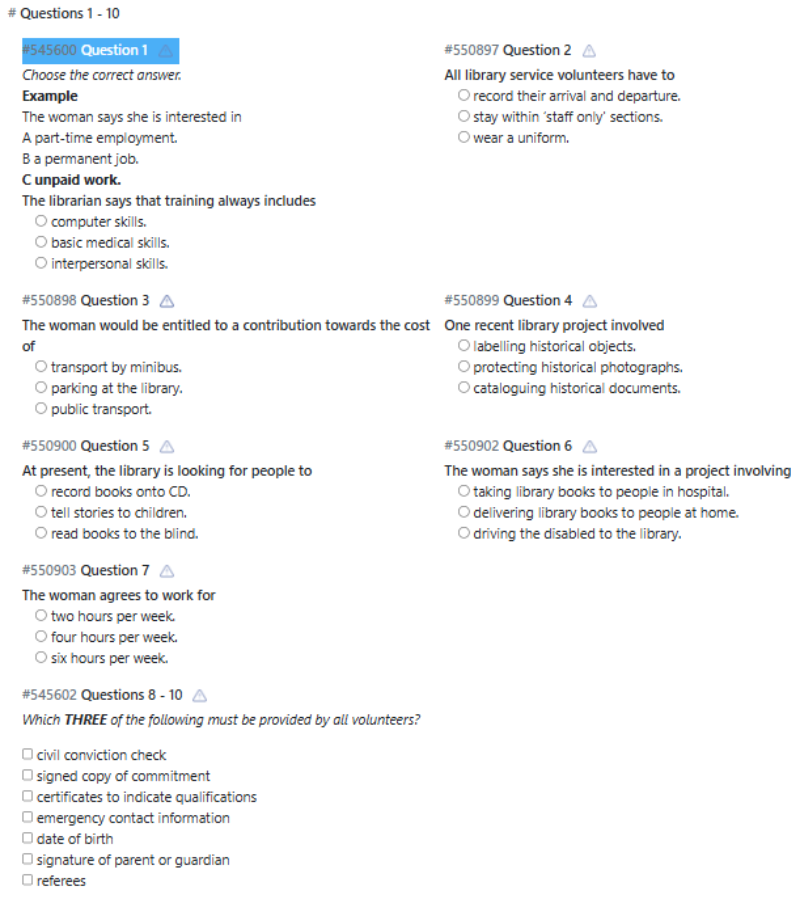
Đáp án:
Question 1 – 7
| Câu | Đáp án |
| 1 | basic medical skills |
| 2 | record their arrival and departure |
| 3 | public transport |
| 4 | protecting historical photographs |
| 5 | record books onto CD |
| 6 | taking library books to people in hospital |
| 7 | four hours per week |
Question 8 – 10:
| Đáp án cần chọn | signed copy of commitment |
| emergency contact information | |
| referees |
Audio transcript:
Woman: Hmm … I’m interested in doing some work for the library – are you the person to speak to?
Librarian: Yes. Right, well, erm, what sort of work are you interested in?
Woman: I’ve just come to live here in Australia. I don’t want a full-time job until my children have settled down, but I really need to get out of the house a bit, and l heard you need voluntary workers (Example) for various projects…
Librarian: Right.
Woman: But I don’t know if I have the right skills.
Librarian: Well, we do provide training.
Woman: Oh.
Librarian: We always include an orientation to the library, together with emergency procedures, that’s fire regulations, emergency exits, first aid. So you can cope with accidents or sudden illness (Q1), things like that which are necessary for anyone who’s working with the public. Then we give specialist training for particular projects – like using our database system.
Woman: I do have quite good computer skills, in fact.
Librarian: Umm great!
Woman: Is there any sort of dress requirement?
Librarian: Well, all staff have to wear a name badge so they can be identified if they go outside the ’staff only’ areas. But apart from that there aren’t many regulations – we ask you to sign in and sign out (Q2) for insurance purposes, but that’s all. How about transport do you live locally?
Woman: Not too far away. I’m at Porpoise Beach. My husband needs the car during the day but it’s only about twenty minutes on the bus.
Librarian: In fact, we can reimburse part of your travel expenses in that case (Q3).
Woman: Oh, would that be the same if I came by car?
Librarian: No, because parking is such a problem here. One thing we are looking for though is someone who can drive a minibus.
Woman: No problem. So do the projects involve going outside the library?
Librarian: Some, yes. But not all. We’ve just finished one which involved working with photographs taken of the area 50 or 100 years ago it basically involved what we call encapsulation… (Q4)
Woman: Putting them in some sort of covers to keep them safe? (Q4)
Librarian: Exactly, it’s time-consuming work, and we were very grateful to have help with it. Then, sometime next year we’re hoping to begin working on an initiative involving the sorting and labelling of objects relating to local history. We’ll be needing help with the cataloguing.
Woman: I’d definitely be interested. How about at present?
Librarian: Well, we have a small team who work to support those who are unable to read.
Woman: Working with the blind.
Librarian: Yes, or other groups who have reading difficulties. We provide volunteers with equipment so that they can take books home with them and read them aloud onto CDs (Q5). We’re gradually building up a collection that can be lent to those who need them.
Woman: Mmm. I can see it would be useful, but I’d really like to do some sort of work where I can get the chance to meet people. How about reading stories to children?
Librarian: Mmm. That’s done by our regular staff. But we do have another project – it’s a very long-established scheme which involves helping those who are unable to have direct access to the library. (Q6)
Woman: Oh. I noticed someone with a trolley of books when I was at the hospital (Q6) last week. That sort of thing?
Librarian: That would have been one of ours, yes. It’s one of our most popular services – lots of people who wouldn’t dream of going to the library normally when they’re at home, borrow a book when the trolley comes round the ward.
Woman: I can imagine. Yes, I’d definitely be interested in that. Right, so how do I enroll?
Librarian: Well, we do ask all volunteers to commit themselves to a regular period each week.
Woman: I could probably do five or six hours.
Librarian: Oh … be careful not to take on too much – but we do need someone for a couple of afternoons from 2 to 4 … so four hours altogether (Q7).
Woman: That sounds fine.
Librarian: Right, so here’s the application form … it asks the usual questions, name and address and telephone number. You also need to fill in details of who we should get in touch with in case of any accident or problem like that (Q8), we do need to have that filled in, and there’s a space for date of birth, but that’s only if you’re over 75, so we won’t worry about that.
Woman: No. Oh. it asks for qualifications do I need to provide certificates?
Librarian: They’re not necessary. We’ll need the names of two referees (Q9), not relatives or family members, obviously. What else … signature of parent or guardian – that won’t be necessary as I assume you’re over 18?
Woman: Yes. What’s this? it says ‘civil conviction check’
Librarian: That’s a document we have to provide by law for those working on projects involving children, so we won’t need it in your case. But you will need to sign this separate document that’s a copy of commitment (Q10), it’s basically an agreement to work according to the library guidelines. So if you’d like to fill this all in – you can do it here, or take it home, whichever you prefer.
Woman: I’ll take it home if that’s OK. Right, well thank you for your time …
Bài viết trên đã cung cấp cho các bạn cái nhìn tổng quan về pick from a list IELTS listening. Nếu còn điều gì thắc mắc, hãy để lại bình luận để Ôn Luyện giải đáp giúp các bạn nhé!
Xem thêm: